

A dissertation abstract is a brief that summarises the purpose of your dissertation. Your dissertation abstract explains the result of your research work in a very summarised manner so that readers can understand what to expect from your paper. There are two ways to write your dissertation abstract. However, abstracts always come at the end once you complete your research, sometimes, according to university guidelines, you are asked to write an abstract before your research part that explains the preliminary research and how you are going to carry on the further research.
In short, a dissertation abstract is a short but structured, summarised section that includes the key points of your research work. An abstract can only be 1 paragraph long, which means it only contains 300–500 words; however, it can be based on your university guidelines. It always takes a separate page in your paper and comes after the page title and acknowledgement section. Writing an abstract for a dissertation can be daunting, but the right step-by-step approach can be helpful. Mastering dissertation writing is not easy at all but can be done with proper steps and expert guidance. Let us dive deeper and discuss the abstract in detail.
What is an Abstract? And what is the purpose of it?
As we now know, an abstract is a short, structured summary of all the main points of your research. Well, students often get confused between an abstract and an executive summary. For your information, these two things are completely different. When you are writing an academic paper, your abstract only explains your research work but does not include the findings. But when you write an executive summary, it includes both. The following points that a good abstract covers are:
- The purpose
- The methodology
- The findings
- The implications
Moreover, every abstract serves two main purposes. The first one is to let your readers know what your paper is about and the findings without reading your entire paper. It just gives a basic understanding of the main idea of your paper, and then your readers decide whether they want to read further or not. The abstract is something that your reader considers before reading your paper.
The SEO perspective provides a second reason for an abstract. Yes, when search engines and abstract databases index your dissertation work, they get information from your abstract. However, since these search engines utilise keywords to classify your dissertation work so that users may readily access it, keywords play a crucial role in this.
The Significance of an Abstract in a Dissertation
An abstract is essential to your dissertation since it provides readers with a concise summary of the key topic of your work. Your abstract will help readers make an informed decision about whether or not to continue reading. Their time is saved by it. You first examine a variety of works on the same subject when writing your literature review, and that is when you discover how important abstract writing is. You study the abstract section of the paper in order to gain knowledge, rather than reading the complete paperwork.
A Step-by-Step Guide to Writing a Dissertation Abstract
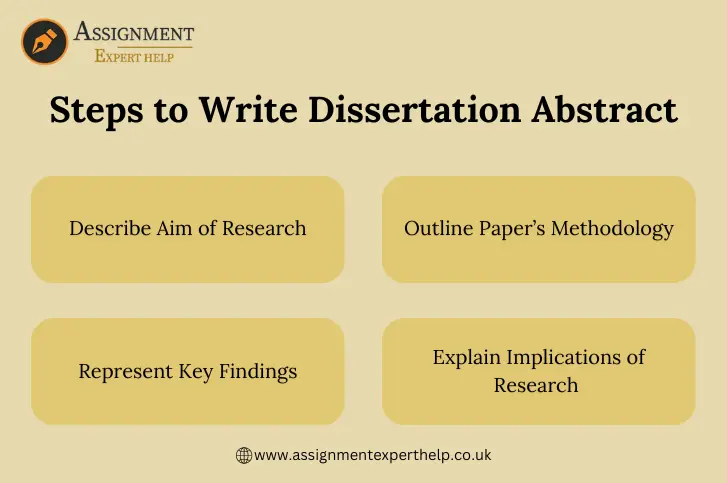
Each dissertation abstract includes four main elements that we have already talked about. Yes, the purpose, the methodology, the findings, and the implications. Your abstract dissertation structure must show all four elements in the same order. Let us discuss them further, one by one.
Describe the Aim of Your Research
In this very first section, you need to clearly state the purpose of your research. Like what your research is about, what it discovers, and why it is so important. It contains two main points:
- What is your research question, and what does it aim to discover?
- Why is your question so important?
Remember, this section is the most important section because this will be your opening part, and as we all know, if the opening is great, then it will hook the readers to read further, right? There is a saying like, the first impression is the last impression, your opening will be interesting and impressive then it will be last longer in your reader’s mind. So keep it clear, concise, and very convincing.
Outline Your Paper’s Methodology
When it comes to explaining the methodology, you have to briefly describe the approaches you have used in your research process. However, methodology isn’t an important section; you can write it when applicable, meaning if you have used any approach in your research work. So when you write your methodology, you address a few elements, such as:
- What method have you used? Was it qualitative or quantitative?
- What does your research consist of?
- What approach did you use for data collection?
- How did you analyse your collected data?
In short, this section includes the how of every part. You have to mention every method, approach, and unique methodology that isn't even relatable to the research but was useful for relatable data collection or any specific tool for data analysis. Remember to keep it short and clear, but it must contain all the answers to the above-mentioned questions.
Represent Your Key Findings
As a next step, you have to add all the facts and findings and briefly and clearly explain how they answer all the questions that you have addressed in the beginning. You have conducted in-depth research on the topic and collected a wide range of data. Now it is time to present all the key findings in your abstract.
Again, clarity is important. Everything that you present must be clear and in a flow that gives a clear understanding to your reader about your paper.
Explain the Implications of Your Research Work
The next and last part of the abstract is to describe the implications. It is all about the “so what?” question. So when you read a long, detailed report and read out all the findings but get a question in your head, so what? That is where implication plays an important part and answers your “so what” question. Remember, when you are writing the implications part, then address the following questions:
- What is the impact of the field that you have investigated and found facts about in the industry and the real world?
- How do your findings impact exciting knowledge, and how do they contribute to the field of research?
- What will be the meaning of your facts and findings in the field of your research in the future?
This is how you get in the right direction in dissertation abstract writing by including these four important elements.
Example of a Dissertation Abstract and Executive Summary
Here, we are sharing an abstract dissertation example and an executive summary example that will give you a clear insight into these two things. So we are taking a research topic, which is “Mental health impact of armed conflicts on children." It's a case study of Syrian refugee children.
Example of an Executive Summary
The psychological effects of armed conflicts on Syrian refugee children are examined in this work, with a particular emphasis on trauma, stress, PTSD, and related disorders. It centres on Syrian refugees, but it also examines more general links between violence, peace efforts, and mental health. Secondary sources, interpretivism, and inductive philosophy, as well as qualitative methods like content analysis and systematic literature review, are all used in this study.
Ethical considerations direct the examination of topics such as cultural adaptation and relocation. Ultimately, the research provides valuable insights into how to address the needs of kids who are internally displaced during times of conflict.
Example of Abstract
The present study elucidated the impact of armed conflicts on the mental health and psychological well-being of Syrian refugee children, resulting in significant issues such as PTSD, stress, trauma, and numerous other mental health conditions. The researchers focused on Syrian refugees because that conflict has led to the largest catastrophe of the modern era, but they also elaborated on and thoroughly explored the relationships between mental health issues, conflicts, and peace development activities.
The utilisation of secondary sources proved to be effective in carrying out qualitative research within the selected field. Secondary sources, explanatory research, interpretivism philosophy, and inductive philosophy all assisted in this study. Secondary sources like design, content analysis, methodical literature review, and ethical issues. Overall, the researchers effectively investigated the ideas selected to address the problems faced by immigrant children and adolescents, including cultural difficulties, family member loss, and displacement.
Tips for Writing a Powerful Abstract
Writing an abstract for your dissertation can be stressful because it will be the hook that will attract your readers, so you want it to be the best. It is all about filtering out the main aspects of your paper and making it relevant and interesting enough for your readers.
While writing your abstract, you can imagine the content according to your reader’s perception. Start with asking questions, “Would I like to read this paper?" Or “What if the readers are not subject experts but are interested in researching this field? Then how should it sound according to their perspective?" So write it according to that. Here, we are sharing a few practical tips for writing a powerful abstract.
Follow WWHS
Here, WWHS means what, why, how, and so what. These four elements must be part of your abstract. Like this:
- What you researched
- Why is your research topic so important?
- How do you research the whole field, and what methods are included in your findings?
- So what were the implications of your findings?
Simplify It
Do not overload your abstract with more words; keep it simple, short, and also very clear so that your readers can easily understand. Remember, using jargon, fancy words, and slang words will only cloud out your main idea and confuse your readers, so avoid that. Keep this in mind while writing your abstract: it should be appealing to all levels of readers.
Keep It Specific
When you write an abstract for your dissertation, keep it clearly specific. Add all the important findings and outline them. Also, do not worry about giving too much information; keep it relatable. Remember that your abstract must be clearly understandable by your readers and convince them to read it further.
Use the Chapter-by-chapter Method
This method will help you come up with the perfect abstract. Make a list of all the keywords and draft your first abstract by outlining the relevance of each chapter of your paper. This brief summary must revolve around your central argument and fill out all the gaps. Once you are done writing it, revise it and edit it if necessary.
Read the Other Abstracts
Out all the abstracts that are based on your field of research and look at how they presented their ideas and what’s unique about them. Read it out, grasp what's interesting, and come up with your unique idea.
Write Multiple Versions of Your Draft
Write multiple versions of your abstract in different ways, and keep the one that sounds perfect. Well, the perfect version won't come until you keep writing and editing.
Keep Editing Until it Looks Compact
Editing is a very essential part of writing an academic paper. so keep editing until it looks perfect. You can also ask someone else to read it for you to get a second perspective. Edit, change the sentences, and remember that the abstract is a compressed piece of your dissertation, so keep it compact.
Final Thoughts
Writing an abstract for a dissertation or thesis can be challenging, but with the right approach, it can be the easiest. In this blog, we have shared everything about writing an abstract in detail, from the purpose of an abstract to writing it in a step-by-step process. It will give you a crystal-clear understanding of abstract writing. Well, there are plenty of dissertation help options available that can also be very helpful for you.
However, this blog is detailed enough, but if you are still looking for some expert help for your dissertation or thesis writing, then you can visit the assignment expert help service. This platform has many qualified subject professionals and skilled writers who offer their guidance 24/7 and provide tailored solutions to every academic query. So, get help and write your polished dissertation abstract.


