

Dissertation Assignments are an integral part of the academic curriculum of courses that students pursue in their higher education. In a dissertation assignment,. students are given a question or a set of questions, on which they have to conduct detailed research to provide answers. The outline of a research project that a student plans to present as part of his or her doctoral program is called a thesis proposal. It acts as a mechanism for composing the final document of the thesis. It seeks to convince the student’s academic committee that the proposed research is original, valuable, and practical. It describes your research question and related topic, as well as what or whom you want to investigate, why, when, where and how you plan to do it. Working on dissertation assignments can be tough and frustrating sometimes as it requires proper research and knowledge to get the best results. Connecting with professionals providing assignment expert help, in such cases can be helpful for students. A dissertation proposal is a vital part of a dissertation assignment.
Students must try their best to create the required dissertation proposal in such a way that not only gets them good grades but also attracts the interest of the readers. They can also reach out to experts to get quality dissertation help and make sure their dissertation writing stands out in the crowd.
Now, let us move forward and explore a few steps that act as the top tips that you must remember while writing a dissertation proposal.
Steps to Write a Dissertation Proposal
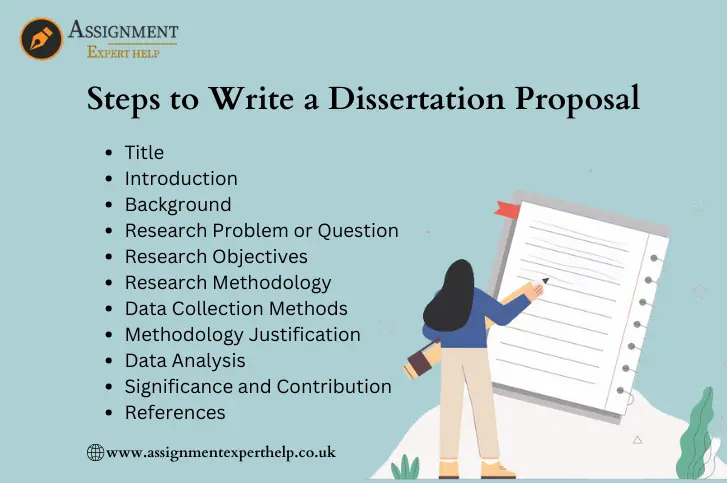
Before you begin working on your dissertation proposal, make sure that you go through the steps given below. This helps in avoiding confusion and saves a lot of time. Here are some detailed steps for writing a dissertation proposal.
1. Title
Your dissertation proposal’s title page is similar to a book cover. It is the first thing people see, so it needs to be clean and appealing. The details it must include are:
- The proposed title of your project
- Your name
- Your supervisor’s name
- Your institution and department
This page creates the atmosphere for your whole proposal hence making it look nice.
2. Introduction
Introduction marks your point of beginning research for your future dissertation. You start by explaining what you will focus on in this writing work. Your intention here is to make readers pay attention to what you are studying. As such, you catch readers’ attention while at the same time making them take an interest in reading your thesis. So, follow this when you write your introduction:
- Introduce your topic
- Give necessary background and context
- Outline your problem statement and research questions
- Conclude making the readers interested to read more
3. Background
Much has been said about this topic in previous research works, therefore, the background section shows its common picture.
Address the following points:
- Why does this subject matter so much to us?
- What all has been studied about it?
- What does the research already done state about it?
- What are all the important points that the readers must know before moving forward?
4. Research Problem or Question
Then we come to writing the dissertation proposal. Come to the point here. This is how you reveal the key question or an inquiry that you have to answer based on your study, or at least what should be found out according to it. You would like your problem statement to be clear and easy to understand by anyone who will read it. So, follow the following points:
- Comparing and contrasting the main theories, methods, and debates
- Examining the strengths and weaknesses of different approaches
- Indicate what your dissertation addresses without ambiguity.
5. Research Objectives
This section deals with what you want to do with your research. Perhaps you need answers to a few inquiries or some insights into a specific area of interest. They help you plan and give direction towards achieving a particular target through research. Therefore, present them in ways that any reader can appreciate why you are studying.
6. Research Methodology
Here is where you outline how your research will be done. Talk about the approaches or techniques that will be used in collecting data and finding solutions. For instance, interviews, surveys, and experiments among others could come up as examples. But you must also know why were these methods chosen and how do they connect with the set goals.
7. Data Collection Methods
Here, you get into the details of how you will collect your data. You explain the specific strategies and techniques you will use, like asking people questions or analysing documents. You want to make sure your methods are thorough and reliable so that your data is accurate. So, you must mention all the methods that you will be using to collect data for the topic of your dissertation writing.
8. Methodology Justification
This part is all about explaining why you chose your research methods. You talk about the strengths and weaknesses of your chosen approach and how you will deal with any challenges that come up. This is a way through which you can show how you have planned for everything.
9. Data Analysis
Once you have collected your data, you need to figure out what it all means. In this section, you explain how you will analyse your data to find patterns or draw conclusions. You might use things like statistical analysis, thematic coding, or any other that you find helpful. The key is to show how your chosen methods will help you make sense of your data.
10. Significance and Contribution
Here, you talk about why your research matters. You explain how it adds to our understanding of the world and why it is important for people to pay attention. You can also discuss how your findings could influence policies or practices in your field. It is all about showing the real-world impact of your work.
11. References
Last but not least, you list all the sources you used in your proposal. This shows that you have done your homework and that your research is based on solid evidence. You must make sure that your references are accurate and properly formatted so that people can easily find the sources that you have used.
It is important for students to focus on this. It lays out your goals, methods, and why your work matters. By following these steps and presenting your ideas clearly, you can set yourself up for success in your research paper or dissertation assignments. Moreover, dissertation help is also available if you need more guidance with the same.
Words to Conclude
To wrap it all up, we can conclude that writing a dissertation assignment can be interesting and tough at the same time. We have discussed some amazing tips and tricks for writing dissertation assignments. As a student, you must try to keep these in mind and try your best to score well in your academic assignments. You can also seek online dissertation help from experts. They can guide you in the right direction and help you out when you feel stuck.


